

The importance of durability in composite materials
Durability is one of the main reasons why composite materials have gained such relevance in sectors like transportation, energy, marine and construction. In addition to combining lightness and strength, composites are capable of maintaining their mechanical and aesthetic properties over long periods of use, provided they are correctly processed.

Train Plates - Transport
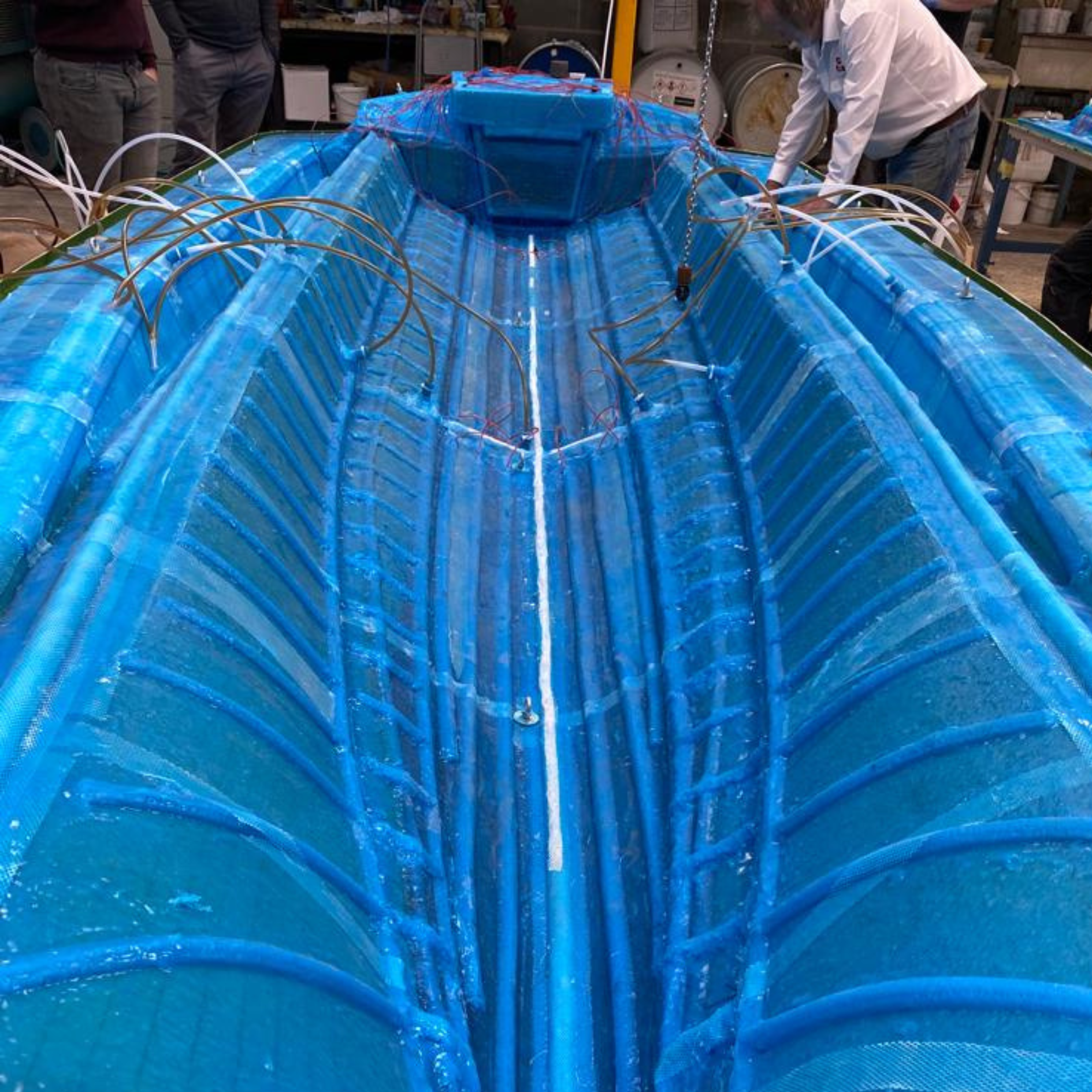
Deck Boat - Marine
However, achieving high durability does not depend solely on the quality of the raw materials. The final performance is directly linked to the precision of the manufacturing process and the control of variables involved at each stage.
Factors influencing durability and final product quality
The longevity of a composite component results from a combination of factors ranging from material selection to environmental control during production. The most relevant include:
Common failures that compromise service life
Even small imperfections can significantly reduce the lifespan of a composite part. Among the most frequent failures are:
- Bubbles and porosity, caused by incomplete impregnation.
- Delamination, due to poor compaction or insufficient adhesion between layers.
- Thickness variations, related to manual application and lack of control over resin flow.
- Improper curing, resulting in deformation and loss of strength over time.
These defects not only compromise structural performance but also increase production costs through rework and part replacement.
The role of fiRST technology in ensuring quality
Among available moulding technologies, the fiRST process stands out for providing precise control over resin impregnation and fibre compaction, two critical factors for the durability of the final product.

In fiRST, infusion takes place within a closed-mould vacuum system using a reusable silicone membrane. This method drastically reduces air entrapment within the laminate and ensures an optimised fibre-to-resin ratio, resulting in stronger parts, with reduced variation between batches and superior surface finish.
Moreover, the process ensures repeatability and dimensional stability, essential factors for the serial production of high-performance components. The use of silicone membranes also contributes to process consistency and waste reduction, preserving both the mould integrity and the surface quality of the parts throughout multiple production cycles.
Control and validation of durability
Durability should never be assumed, it must be verified. Tests such as tensile, impact, fatigue and moisture resistance are essential to assess composite integrity and validate the expected performance.

Additionally, implementing in-process quality control routines (such as vacuum integrity checks or ultrasonic inspection) allows defects to be identified before they affect large-scale production.
When control is consistent, the result is a predictable and reliable product, a fundamental requirement for industries that prioritize safety and efficiency.
Conclusion
The durability of a composite is not determined solely by the materials used, but mainly by how they are processed. Final quality is the direct outcome of attention to mould design, surface preparation, process control and the technology applied.
With the VPI process, it is possible to achieve an ideal combination of surface quality, structural integrity and repeatability. As a result, durability ceases to be an uncertain consequence and becomes a predictable outcome, essential for those seeking efficiency and reliability in composite manufacturing.
follow us on social media!
Contact Us Today
Want to learn more about or Vortex Injection Valve or any other products & services? Reach out to our team today.


