

What Are Composite Materials?
Defining Composites. Nature’s Original Engineering
At its simplest, a composite material is the deliberate combination of two or more constituent materials, each with distinctly different physical or chemical properties, to produce a new material whose performance surpasses that of any individual component. One material typically serves as the matrix (the binder), whilst the other acts as the reinforcement (providing strength or stiffness).
This is a principle as old as civilisation itself. Long before polymer chemists coined the term “fibre reinforced plastics,” ancient builders understood that combining materials could yield something remarkably greater than the sum of its parts. Indeed, the history of composite materials is, in many ways, the history of human ingenuity, a continuous thread running from Mesopotamian brickyards to the autoclaves of modern aerospace facilities.

Ancient mud brick

Modern carbon fibre aerospace panel
Ancient Composites: Where It All Began
Mud Bricks and Straw. Mesopotamia (3400 BC)
The earliest known composite materials date to approximately 3400 BCE in ancient Mesopotamia. Builders discovered that mixing mud with straw, an agricultural waste product, produced sun-dried bricks of remarkable durability. The principle was elegant: dried mud provided compressive strength, whilst the straw fibres distributed tensile loads and resisted cracking. Consequently, neither material alone could match the performance of the two combined.
This was not accidental. It was deliberate material engineering, practised at scale across Mesopotamia and Egypt for millennia. Moreover, the same fundamental concept, embedding reinforcement fibres within a binding matrix, underpins every composite manufactured today, from glass-reinforced plastic boat hulls to carbon fibre Formula 1 monocoques.


Mongolian Composite Bows. Early Engineered Laminates
Perhaps the most sophisticated composite of the ancient world was the Mongolian composite bow, a weapon whose layered construction would not look out of place in a modern composites textbook. Dating back centuries (with the refined design prominent by around 1200 CE), these bows combined a wood core with animal sinew bonded to the back and horn affixed to the belly, all held together with animal-hide glue acting as the matrix.
The engineering logic was precise. Sinew excels in tension; horn excels in compression; wood provides the structural backbone. When drawn, each material worked within its optimal stress regime. As a result, the bow was a compact yet devastatingly powerful weapon, far superior to any simple wooden bow, that gave Genghis Khan’s mounted archers a decisive military advantage across the Eurasian steppe.

Egyptian Cartonnage and Papyrus Laminates
Ancient Egypt contributed its own innovations to the composite story. As early as 3000 BCE, Egyptians produced papyrus by layering thin strips of reed at right angles and pressing them together, effectively creating a laminated composite. The cross-ply arrangement distributed loads in multiple directions, a principle that modern engineers recognise instantly.
By around 2000 BCE, Egyptian artisans had developed cartonnage: layers of linen or papyrus bonded with plaster to create lightweight yet rigid structures for mummy cases and funerary masks. This is arguably one of the earliest examples of a fibre-reinforced matrix composite produced for a specific structural and aesthetic purpose. Furthermore, these techniques demonstrate that early civilisations already understood the value of multi-directional reinforcement.

The Industrial Revolution and Early Synthetic Composites
Bakelite and the Birth of Reinforced Plastics
The modern era of composite materials begins in 1907, when Belgian-American chemist Leo Baekeland created Bakelite, the world’s first fully synthetic plastic. A phenol-formaldehyde resin, Bakelite was frequently reinforced with wood flour, asbestos, or woven fabric to improve its mechanical properties. In doing so, Baekeland had inadvertently created one of the first synthetic composite materials.
Bakelite transformed electrical insulation, consumer goods, and industrial components. More importantly, it demonstrated that synthetic polymers could serve as effective matrices for reinforcement fibres, opening a door that the composites industry would charge through in the decades to come.

Fibreglass Arrives (1930s)
Glass fibres are not a twentieth-century invention. Artists and craftspeople had drawn fine filaments of glass for centuries — most famously, the French artist René Lambourg created exquisite works like Lion et Serpent en Verre Filé (1830–1855) using hand-drawn glass fibres. However, artistic glass-working and industrial-scale composite manufacturing are fundamentally different endeavours.

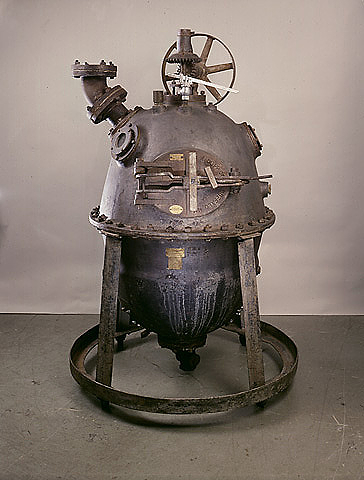
The pivotal moment came in 1932, when Games Slayter, a researcher at Owens-Illinois, accidentally drew fine filaments of glass whilst conducting experiments on glass wool insulation. This breakthrough, combined with the newly formed Owens-Corning Fiberglas™ corporation’s decision in 1935 to invest heavily in glass fibre production technology, transformed the landscape. Owens-Corning’s achievement was not the invention of glass fibres themselves, but the development of reliable, scalable manufacturing processes capable of producing glass filaments in industrial quantities at controlled properties.
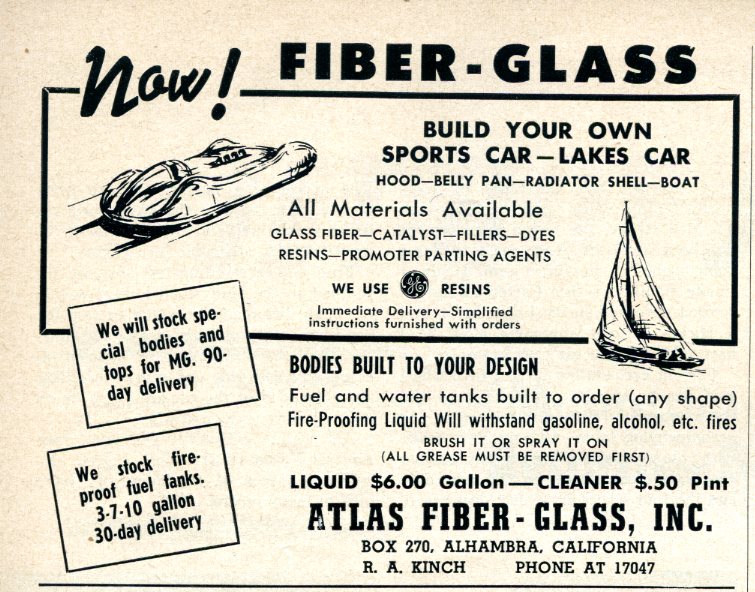
When these machine-produced glass fibres were combined with polyester resin, the result was glass-reinforced plastic (GRP) — commonly known as fibreglass — the material that would democratise composites and bring them into mainstream manufacturing. The first commercial fibreglass products appeared in the late 1930s. However, it was the coming global conflict that would truly accelerate the evolution of composite manufacturing and transform fibreglass from a laboratory curiosity into a strategic material class.
Hot Rod Magazine, October 1952

Road and Track, February 1953
World War II. The Catalyst for Modern Composites
Military Applications and Rapid Innovation
If there is a single inflection point in the history of composite materials, it is the Second World War. Between 1939 and 1945, the urgent demands of military production transformed composites from a laboratory curiosity into a critical strategic material class.
GRP proved ideal for radar domes (radomes) because it was transparent to electromagnetic signals, a property no metal could offer. Additionally, aircraft manufacturers exploited composite construction for weight savings: the legendary De Havilland Mosquito of 1941 featured a plywood-and-balsa sandwich composite fuselage that made it one of the fastest aircraft in the Allied fleet. Meanwhile, the United States Navy experimented with fibreglass-reinforced boat hulls, whilst composite materials found their way into parachutes, helmets, and structural panels across every theatre of war.


Crucially, the vast wartime investment in research and development created a body of knowledge, and a generation of skilled engineers, that would transfer directly into civilian industry once peace returned. Therefore, the post-war composites revolution was built squarely on wartime foundations.
Post-War Boom: Composite Materials in Aerospace, Automotive and Marine
Carbon Fibre Development (1960s–1970s)
The 1950s saw fibreglass go mainstream. The 1953 Chevrolet Corvette became the first major production car with a fibreglass body, and GRP rapidly conquered the boat-building, surfboard, swimming pool, and storage tank markets. But the true game-changer was still to come.

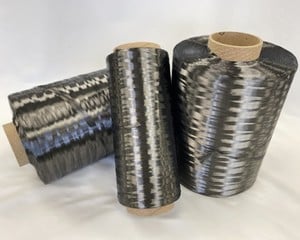
In 1958, Roger Bacon at Union Carbide produced the first carbon fibres from a rayon precursor. Then, in 1963, researchers at the United Kingdom’s Royal Aircraft Establishment (RAE) in Farnborough achieved a critical breakthrough. Subsequently, in 1964, Dr Akio Shindo in Japan demonstrated high-strength carbon fibre derived from polyacrylonitrile (PAN). By 1966, William Watt, Leslie Phillips, and William Johnson at the RAE had refined the PAN-based process to a level suitable for industrial application.
Carbon fibre offered a strength-to-weight ratio that was nothing short of extraordinary, approximately five times stronger than steel at a fraction of the weight. It was the material the aerospace industry had been waiting for.

Roger Bacon
High-strength carbon fibre derived from polyacrylonitrile (PAN)

Phillips, Watt and Johnson with the carbon fiber nosecone
Composite Materials in Aerospace Engineering
Through the 1970s and 1980s, the use of composite materials in aerospace surged dramatically. Military aircraft, the F-14 Tomcat, F-15 Eagle, F-16 Fighting Falcon, and the Harrier, incorporated increasing proportions of carbon fibre composites in structural components. Similarly, the Space Shuttle relied on extensive composite thermal protection and structural elements.

F-14 Tomcat

F-16 Fighting Falcon
Commercial aviation followed suit. Airbus and Boeing began integrating composites into airframe structures during the 1980s, a trend that culminated in two landmark aircraft: the Boeing 787 Dreamliner (2009), with 50% composite content by weight, and the Airbus A350 XWB (2013), at 53%. These aircraft represent the most visible testament to how composite materials have reshaped modern engineering.
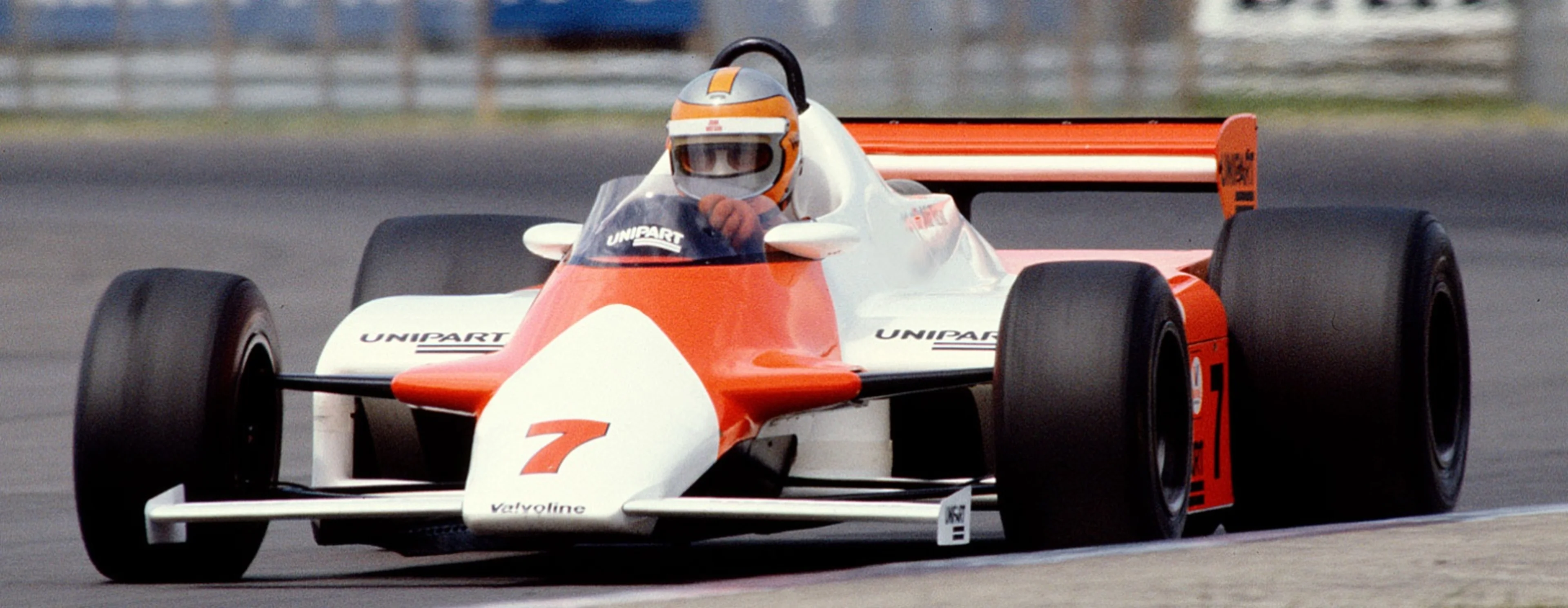
In motorsport, the 1981 McLaren MP4/1, designed by John Barnard, became the first Formula 1 car with a full carbon fibre monocoque, setting a safety and performance standard that every team on the grid would eventually adopt.

Airbus A350 XWB (2013)
1981 McLaren MP4/1
Growth of the Marine and Wind Energy Sectors
GRP became the dominant hull material for pleasure craft, patrol vessels, and lifeboats from the 1960s onwards. Sandwich construction, GRP skins bonded to a foam or balsa wood core, delivered exceptional stiffness-to-weight performance for hulls and decks, with the added benefits of corrosion resistance and dramatically lower maintenance compared to wood or steel.
By the 1990s, the wind energy sector had emerged as one of the largest consumers of composite materials globally. Turbine blades were manufactured almost exclusively from glass and carbon fibre reinforced polymers using vacuum infusion processes. Consequently, the types of composite materials in use expanded rapidly to meet diverse industrial demands.

Wind Turbines

Wind Turbine Production
The Rise of Advanced Composite Manufacturing Processes
Hand Lay-Up to Autoclave. The Process Evolution
The evolution of composite manufacturing processes mirrors the evolution of the materials themselves. Each generation of process technology addressed the limitations of its predecessor, driving improvements in quality, repeatability, production speed, and worker safety.
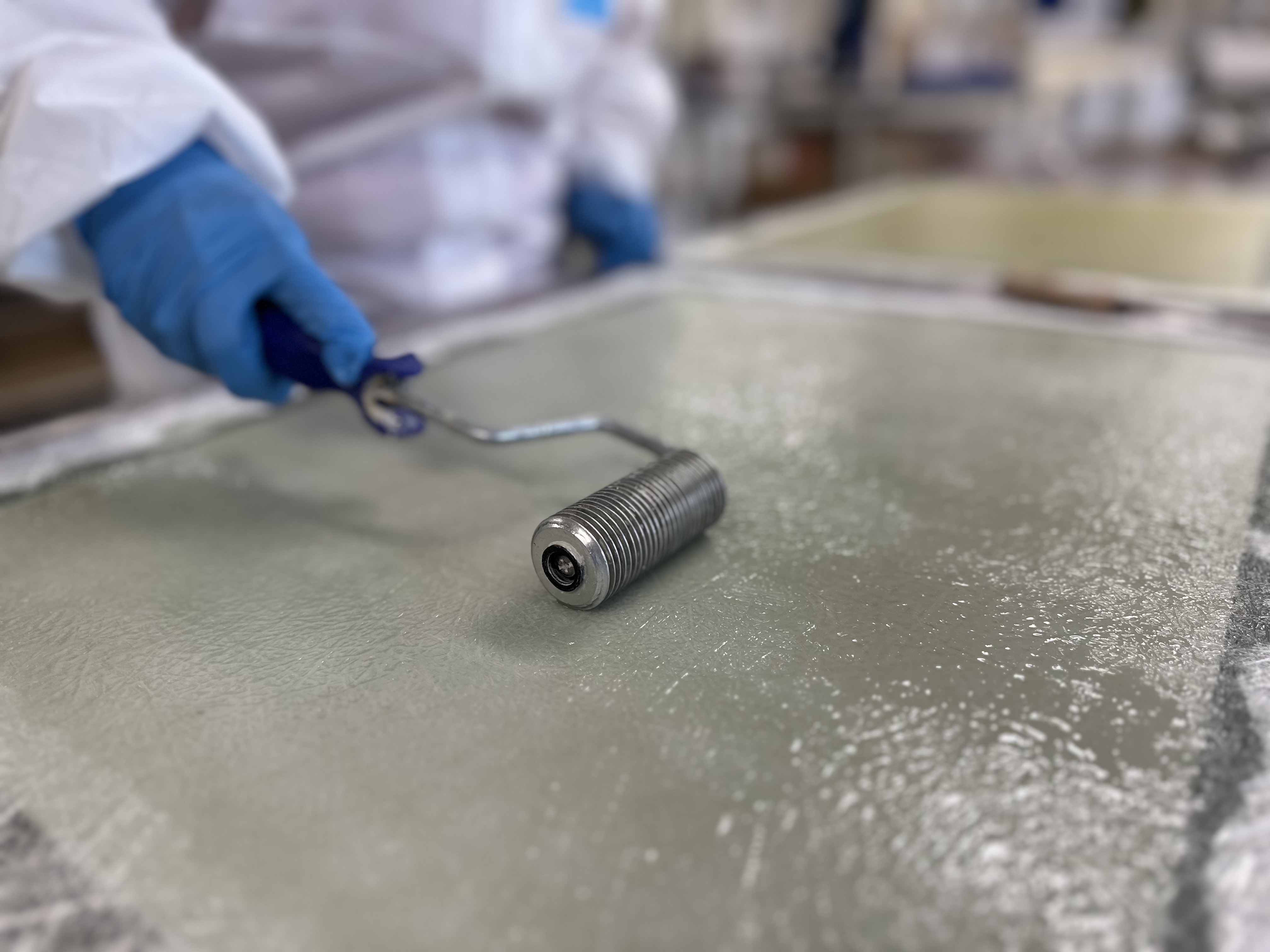
Hand lay-up
The oldest technique still in use, dates to the 1940s. An operator manually places dry reinforcement, glass mat or woven cloth, into an open mould and applies catalysed resin with a brush or roller. It demands minimal capital investment but is labour-intensive, skill-dependent, and produces variable quality alongside high volatile organic compound (VOC) emissions.
Spray-up
Introduced in the 1950s, improved speed by simultaneously spraying chopped fibre and catalysed resin into an open mould. Although it was faster than hand lay-up, it shared the same open-mould limitations, including VOC exposure and inconsistent fibre distribution.

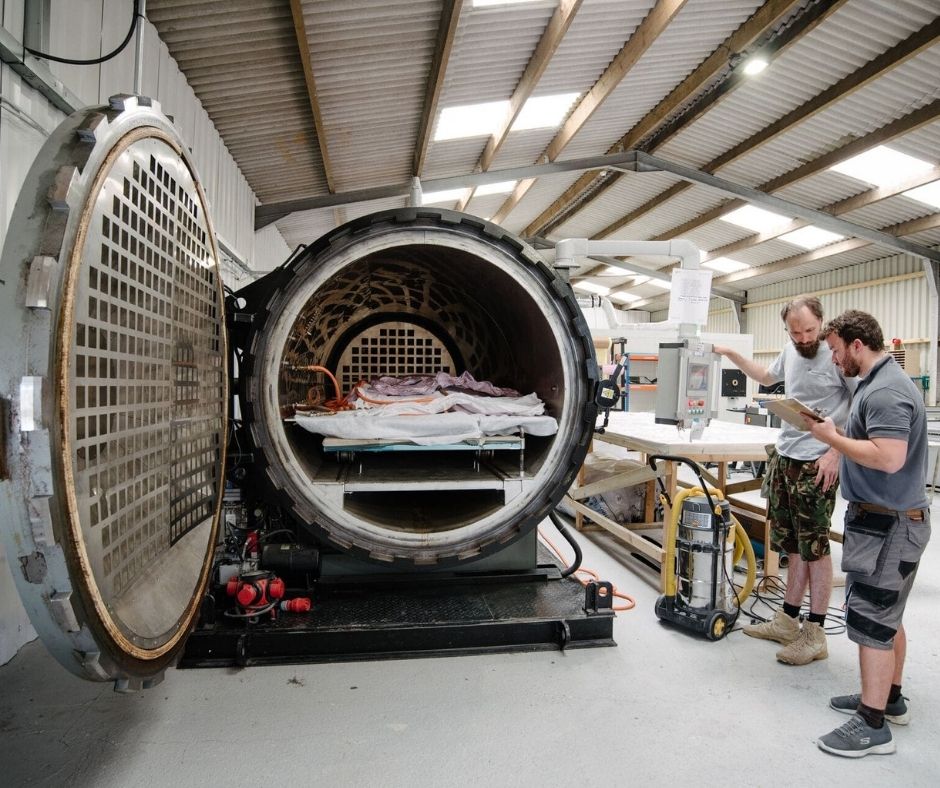
Autoclave curing
Developed from the 1960s onwards, became the gold standard for aerospace-grade composites. Pre-impregnated reinforcement (prepreg) is vacuum-bagged and placed inside a pressurised, heated vessel. The combination of heat, pressure, and vacuum produces laminates of exceptional quality and consistency. However, autoclaves can cost millions of pounds, cycle times are slow, and the process remains confined to high-value applications where cost is secondary to performance.
Vacuum Bagging and Resin Infusion
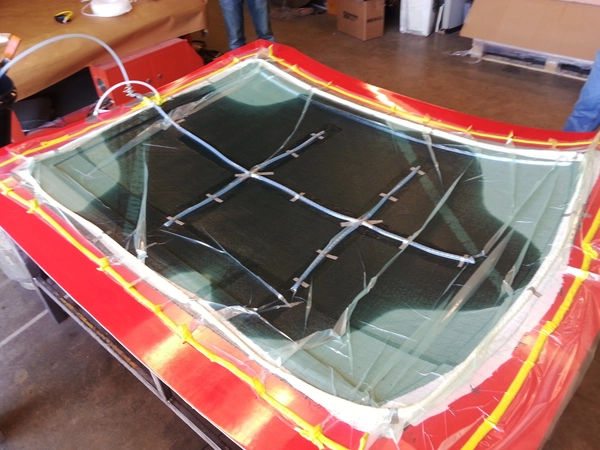
Vacuum Bagging
Refined over decades from its wartime origins, marked a significant step forward for open-mould manufacturing. A consumable plastic film is sealed over the wet laminate and vacuum is drawn to consolidate the lay-up, remove trapped air, and improve the fibre-to-resin ratio. The resulting laminates are meaningfully superior to those produced by hand lay-up alone.
Yet vacuum bagging carries a fundamental drawback: every single production cycle consumes a fresh set of plastic film, breather fabric, peel ply, and flow media — all of which go straight to landfill after a single use. For manufacturers producing hundreds or thousands of parts, the cumulative waste, cost, and environmental impact is staggering. As a result, the search for effective vacuum bagging alternatives has intensified in recent years.

Vacuum Assisted Resin Transfer Molding (VARTM)
Which gained widespread traction in the 1990s, took the concept further. Dry reinforcement is laid in an open mould under a vacuum bag, and resin is drawn through the laminate by vacuum pressure alone. The process delivers excellent fibre volume fractions, lower VOC emissions, and is the method of choice for large structures such as wind turbine blades and marine hulls. Nevertheless, it too relies on single-use consumable bags and ancillary materials.
Injection Moulding for Composites
Resin Transfer Moulding (RTM)
Developed from the 1970s, introduced closed-mould processing. Dry reinforcement is placed between matched male and female moulds, and resin is injected under pressure. The result is excellent surface finish on both sides, tight dimensional control, and faster cycle times than open-mould methods. Light RTM (LRTM) variants use vacuum assistance with lighter counter-moulds, reducing tooling cost.
The composite manufacturing process evolution has been relentless, from the simplest hand lay-up through to automated fibre placement (AFP) and automated tape laying (ATL) systems that dominate modern aerospace production lines. Each advance has brought composites closer to the efficiency, repeatability, and sustainability that twenty-first-century industry demands.

What Comes Next?
The history of composite materials is a story of relentless progress, from Mesopotamian mud bricks to aircraft that are more composite than metal. But for all the advances in materials and design, one challenge has persisted stubbornly across decades: the manufacturing process itself.
Vacuum bags, release films, breather fabrics, flow media, the consumable materials that underpin most composite production methods remain fundamentally single-use. They generate enormous volumes of waste, add significant per-part cost, and introduce variability that even the most skilled operators struggle to eliminate entirely.
What if there were a better way? What if a single reusable tool could replace hundreds, even thousands, of disposable consumable sets?
In Part 2, we explore exactly that: how Alan Harper Composites has spent over fourteen years developing fiRST® reusable silicone membrane technology, a breakthrough that is transforming sustainable composite manufacturing across the globe. The next chapter in the history of composites is already being written.
Follow us on social media
Contact Us Today
Want to learn more about or Vortex Injection Valve or any other products & services? Reach out to our team today.


