
When sustainability is discussed in the composites industry, the focus is often placed on new materials, bio-based resins, or alternative fibres. While these developments are important, they do not address one of the most significant sources of environmental impact in composite manufacturing: waste generated by the production process itself.
In many cases, the largest volume of waste is not found in the finished part, but in the auxiliary materials required to manufacture it. Conventional vacuum infusion is a clear example of this and remains widely used across multiple composite sectors.
Waste generated by conventional vacuum infusion
In traditional vacuum infusion processes that rely on disposable vacuum films, every production cycle generates a considerable amount of waste. Vacuum plastic, spiral wrap, tacky tape and other consumables are used once and discarded after each part is produced.

This happens repeatedly, day after day, across many factories worldwide. Over time, this approach leads to significant volumes of industrial waste, as well as recurring costs related to purchasing, handling and disposing of these consumables.
Time, complexity and hidden inefficiencies
Material waste is only part of the problem. Preparing a mould for conventional vacuum infusion is a manual, multi-step operation that relies heavily on operator experience. Each consumable must be positioned correctly, and every seal must be rebuilt for every production cycle.
The more disposable components involved, the greater the number of variables in the process. This results in longer preparation times, increased risk of errors, rework, and ultimately additional material and time losses.
Silicone membranes: a structural change in the infusion process
By replacing disposable vacuum systems with a silicone membrane, the logic of the vacuum infusion process changes fundamentally. Disposable consumables are eliminated because the elements required for infusion are integrated into the membrane itself.

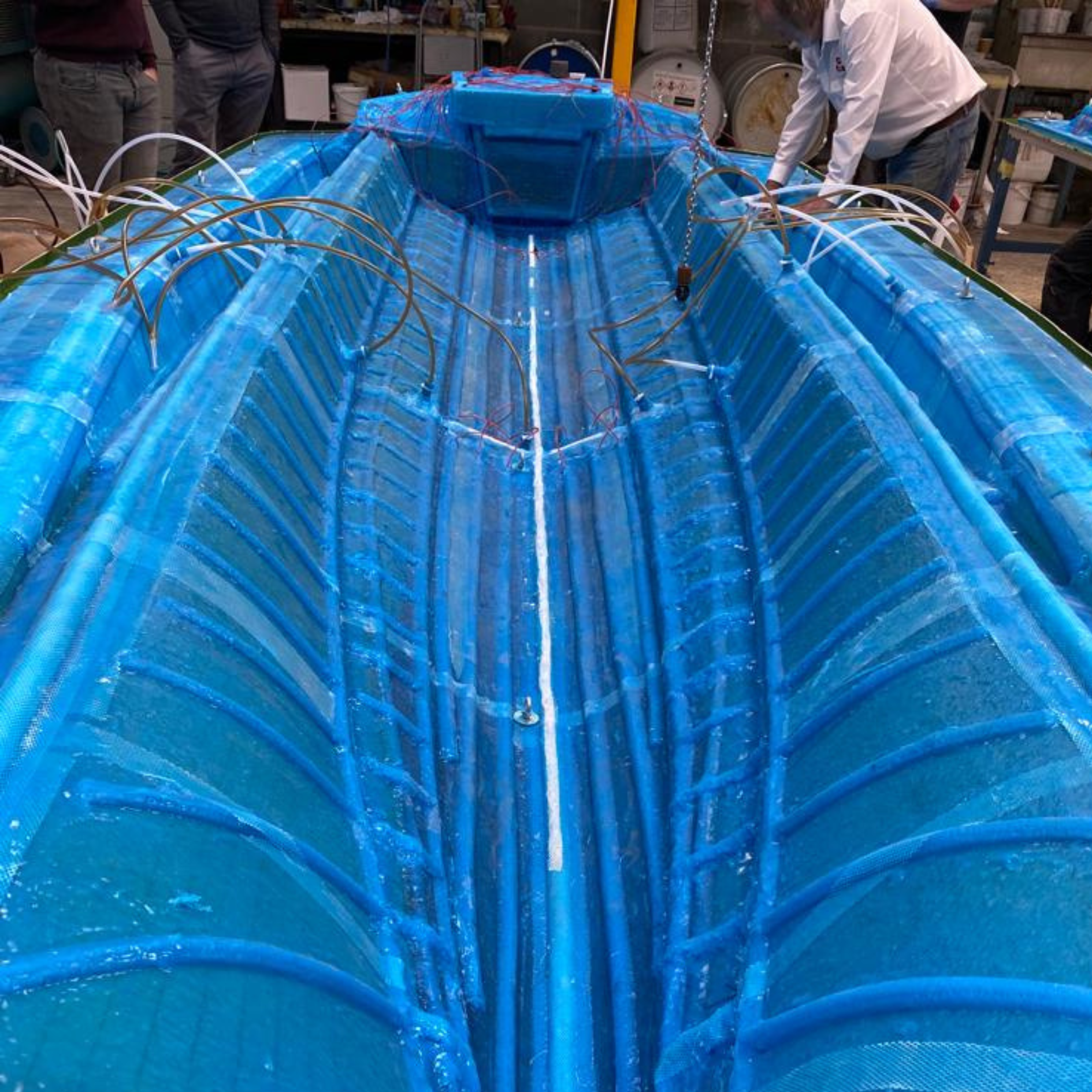
There is no vacuum plastic to discard, no spiral wrap and no tacky tape. The process becomes closed, repeatable and significantly cleaner, directly reducing the amount of waste generated during composite manufacturing.
Reduced preparation time and improved efficiency
From an operational perspective, the impact is immediate. Mould preparation shifts from a complex assembly of multiple components to a simple, standardised step. Instead of positioning numerous small consumables, the operator only needs to position the silicone membrane and apply vacuum.

Fewer steps mean shorter setup times, reduced manual intervention and greater process predictability. The result is shorter production cycles, improved repeatability between parts and a more efficient industrial operation.
Sustainability as a consequence of good process design
In this context, sustainability is no longer an abstract concept, but a direct consequence of sound technical decisions. Eliminating disposable consumables, simplifying vacuum infusion processes and improving production efficiency have a measurable impact on both environmental performance and operational costs.
Rather than focusing solely on material substitution, this approach addresses waste at its source by redesigning the manufacturing process itself.
JEC Paris 2026: discussing sustainable composite processes
These topics are central to the discussions taking place at global industry events such as JEC Paris 2026. The exhibition has become a key platform for sharing knowledge about more efficient, repeatable and sustainable composite manufacturing processes.

We will be exhibiting at JEC Paris 2026, Booth 5L 143, where we will be discussing how process design choices, particularly in vacuum infusion and closed moulding can significantly reduce waste, shorten production time and improve overall efficiency.
By looking at sustainability through the lens of process optimisation, the composites industry takes a decisive step towards cleaner, more industrialised and future-ready manufacturing.
Follow us on social media
Contact Us Today
Want to learn more about or Vortex Injection Valve or any other products & services? Reach out to our team today.


